
Inside Tow Ball Bike Rack Factories: Engineering Excellence
The modern cycling market demands more than convenience—it demands engineering precision. As electric bikes become heavier and vehicles more varied, ordinary rear racks can no longer guarantee stability or safety. That’s why advanced manufacturing is key. INNRACK, a globally recognized tow ball bike rack factory, blends design intelligence, testing expertise, and industrial innovation to meet the evolving needs of distributors and end users worldwide.
The Shift from Generic Designs to Engineered Systems
Traditional racks once prioritized simplicity over structure. But growing e-bike weight, uneven roads, and higher highway speeds pushed factories to reinvent their designs. INNRACK’s engineering process focuses on three structural foundations:
-
Load Transfer Precision: Even distribution of vertical and torsional force through reinforced tow ball sockets.
-
Multi-Axis Stability: Dual-arm locking systems prevent side sway during cornering.
-
Quick-Fit Safety Locks: Minimize vibration while allowing tool-free setup.
These principles ensure every rack performs consistently across different terrains and driving conditions—critical for distributors supplying diverse markets.
Inside the Manufacturing Line: Where Precision Meets Durability
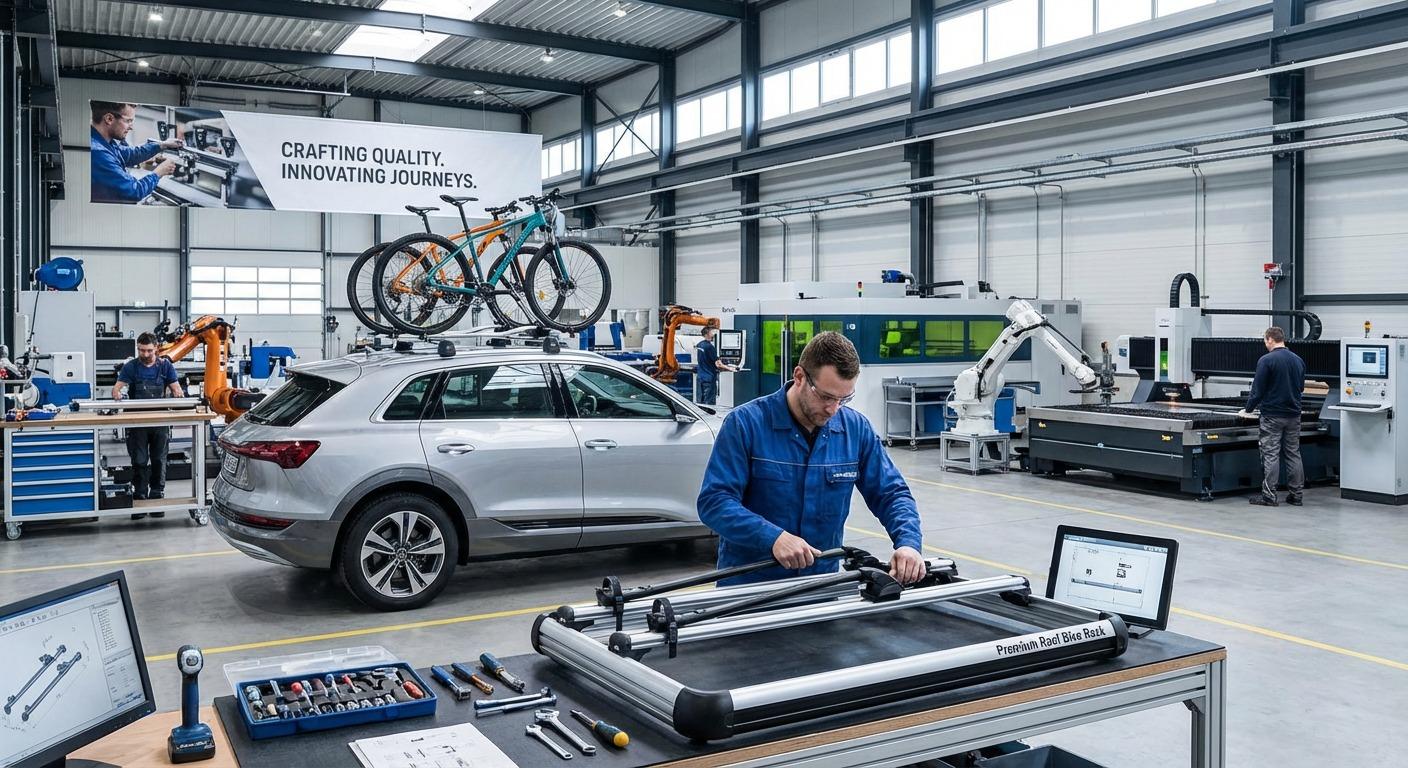
Every tow ball bike rack begins as raw aluminum or high-tensile steel. INNRACK’s facility integrates CNC tube bending, robotic welding, and multi-stage powder coating to produce consistent results.
| Production Stage | Process | Key Outcome |
|---|---|---|
| Tube Forming | CNC bending within ±0.2 mm tolerance | Structural symmetry and fit accuracy |
| Welding | Robotic MIG welding | Uniform joints with high load endurance |
| Surface Treatment | Sandblast + Powder coat | Corrosion and UV resistance |
| Assembly & QC | Pre-assembly inspection | Reduced end-user installation issues |
This vertical integration allows INNRACK to deliver complete OEM orders faster and with fewer defects, supporting large-scale distribution with dependable consistency.
Testing Beyond Standards: Where Certification Meets Reality
Most factories stop at basic certification. INNRACK goes further. Every model undergoes a simulation of real-world fatigue, high-speed wind pressure, and corrosion exposure.
-
Dynamic Load Testing: Replicates continuous driving at 110 km/h with dual-bike loads.
-
Salt-Spray Resistance: 240-hour exposure confirms longevity in coastal and winter markets.
-
Torsion & Impact Testing: Ensures frame integrity under sudden braking or bumps.
These tests aren’t marketing claims—they translate directly into lower return rates and higher distributor satisfaction.
OEM Collaboration: Tailored Engineering for Global Brands
INNRACK’s OEM clients often seek differentiation—sleeker aesthetics, smart lock systems, or foldable frames. The factory supports this through a co-engineering process:
-
Concept Development – Align product design with brand positioning.
-
3D CAD Modeling & Prototype Simulation – Visualize load paths and locking angles.
-
Trial Production & Validation – Deliver pilot samples within two weeks.
-
Mass Production & Branding – Apply laser-engraved logos and region-specific packaging.
For automotive accessory brands, this partnership model reduces R&D cost and accelerates entry into competitive markets while ensuring compliance with EU and North American safety regulations.
Field Insights: Real-World Solutions for Common Buyer Challenges
| Buyer Pain Point | INNRACK’s Solution |
|---|---|
| Heavy e-bike instability | Reinforced support arms with dual clamps |
| Limited trunk access | Fold-down hinge system for easy boot access |
| Long-distance travel durability | Double-coated steel with anti-corrosion finish |
| High freight costs | Modular foldable structure for compact shipping |
| Retail customization | Private label packaging and instruction localization |
These engineering adjustments don’t just improve the end-user experience—they directly impact distributors’ profitability and brand trust.
Q&A: What Buyers Want to Know
Q1: How is INNRACK different from other tow ball bike rack factories?
A: Unlike standard exporters, INNRACK manages full in-house production—from design to coating—ensuring unmatched quality control and rapid customization.
Q2: Can INNRACK handle exclusive regional models?
A: Yes. The factory supports exclusivity agreements and adapts mounting systems to specific vehicle markets across Europe, Australia, and North America.
Q3: What is the expected product lifespan?
A: Under normal use, INNRACK tow ball racks maintain structural integrity for 8–10 years, validated by corrosion and fatigue testing.
Driving Innovation, One Rack at a Time
Behind every INNRACK product is a philosophy of engineering without shortcuts. The company’s dedication to quality, innovation, and OEM partnership has made it a benchmark in global manufacturing. For distributors and automotive brands, partnering with INNRACK means more than sourcing—it means confidence in every journey.
Ready to collaborate with a factory that builds reliability into every frame?
Visit our homepage or contact us here to begin your OEM project with INNRACK, where precision meets performance.